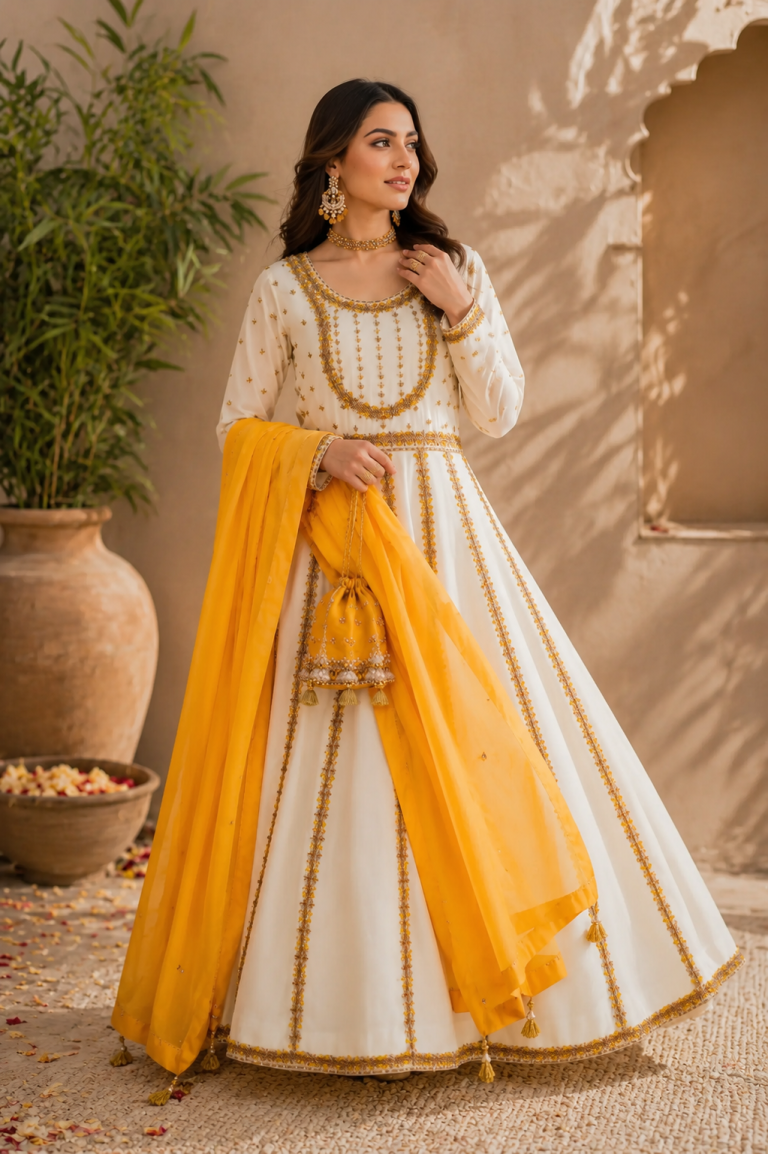
Behind every creation that leaves the Nooraiza atelier lies an unbroken lineage of master craftsmanship passed down through generations of South Asian karigars. Among our most cherished traditions is the art of authentic Zardozi—an intricate, dimensional hand-embroidery technique that once adorned the imperial courts of the Mughal dynasty. In a contemporary fashion landscape increasingly dominated by computerized machine stitching and fleeting trends, the dedication required to produce genuine hand-laid metal embroidery stands as a testament to true luxury.
To understand Zardozi is to understand the dialogue between metal, silk, and human patience. The word itself derives from two Persian roots: Zar, meaning gold, and Dozi, signifying embroidery. Historically, royal ateliers utilized hammered wires of pure gold and refined sterling silver to embellish ceremonial robes, royal canopies, and courtly slippers. Today, while metallurgical alloys and micro-gilt wires have evolved for contemporary durability and wearable weight, the essence of the craft remains wholly untouched: a wooden frame, an artisan’s practiced eye, and the rhythmic percussion of the needle working millimeter by millimeter.
The Alchemy of Metallic Threads: Dabka, Nakshi, and Bullion Wires
Unlike flat thread embroidery such as resham or satin stitch, Zardozi creates a sculptured, three-dimensional topography across the surface of the textile. This dimensional relief is achieved through specialized materials that require distinct handling techniques:
- Dabka: A spring-like, coiled wire that is extraordinarily supple. Master artisans cut dabka into micro-segments, threading each piece onto a needle before couching it down. The coiled structure catches ambient light from multiple angles, creating a shimmering, radiant glow that shifts as the wearer moves across the room.
- Nakshi: Similar in structure to dabka but intentionally textured with minute crimps or ridges. This textural corrugation produces a sparkling, starlight dispersion rather than a smooth sheen, making it ideal for defining architectural borders and petal contours.
- Kora and Tilla: Duller, matte metallic wires that provide tactile contrast against brilliant polish. In high couture, luxury is defined by subtlety; alternating high-shine dabka with matte kora creates depth and visual sophistication.
- Sitara (Sequins) & Pota: Antique-finished metallic discs and tiny seed beads anchored with cross-stitched wires, frequently utilized to fill floral motifs and add rhythmic surface texture to our Luxury Formals.
Every single metallic coil must be cut by hand to precise tolerances. If a wire segment is half a millimeter too long, it will buckle and snag; if too short, the tension will distort the underlying pure silk weave. This precision demands years of apprenticeship under master ustads.
The Anatomy of the Adda: The Atelier Loom
The creation of any bespoke Nooraiza formal begins at the adda—the heavy, horizontal wooden embroidery frame made from seasoned timber. The fabric, whether it is high-tensile 80g pure raw silk or whisper-light French organza, is stretched across the frame with uniform tension. Achieving drum-tight tension is critical: any variance across the warp or weft will result in puckering once the completed garment is cut and draped over the body.
Once mounted, the master artisan traces the design onto the fabric using tracing chalk or naturally dyed powders mixed with kerosene. The pattern maker must account for the natural drape, seam lines, and weight distribution of the finished ensemble. A heavy bridal neckline adorned with zardozi requires strategic structural reinforcement on the underside to ensure the collar sits flush against the collarbone without collapsing or pulling backward.
“True zardozi does not simply decorate a fabric; it transforms the textile into an architectural sculpture. The metal wire gives the silk memory, weight, and presence.”
Differentiating Authentic Hand Zardozi from Commercial Machine Embroidery
As the international demand for Pakistani luxury wear has surged, the market has seen an influx of computerized machine imitations marketed under the broad banner of formal wear. For the discerning collector and modern bride, knowing how to identify authentic handcrafting is paramount:
- The Underside of the Textile: The clearest indicator of authenticity lies on the reverse side of the garment. Machine-stitched embroidery leaves a dense, uniform web of synthetic bobbin threads that feels stiff and abrasive against bare skin. Hand zardozi, by contrast, features minimal reverse anchoring, with clean knots and couching stitches that leave the reverse side smooth and supple.
- Dimensional Tactility: Machine embroidery is fundamentally two-dimensional; needles press flat against the textile. Hand zardozi produces raised, tubular ridges that rise 2 to 4 millimeters above the cloth surface, providing an unmistakable sculptural depth.
- Flexibility and Fluid Drape: Industrial stitching stiffens the fabric, resulting in an unnatural cardboard-like rigidity. Hand-laid metallic threads, applied with flexible human tension, flex naturally with the movement of the silk, preserving the graceful, fluid drape of an A-line kalidaar or floor-length bridal peshwas.
- Organic Nuance vs. Mechanical Monotony: Look closely at the curves of a hand-embroidered floral motif. You will notice microscopic, harmonious variations that demonstrate the artisan’s intuition. Machine work is mechanically identical and lacks the soulful warmth of human hands.
Modernizing the Imperial Aesthetic: Weightless Luxury
One of the historical challenges of imperial zardozi was sheer garment weight. Traditional court robes could weigh upwards of 15 to 20 kilograms, making them majestic but physically exhausting to wear. At Nooraiza, our contemporary design philosophy balances historical grandeur with modern ergonomics.
We achieve this through strategic weight mapping. By anchoring dense zardozi on areas requiring natural structure—such as waistbands, cuff edges, and shoulder yokes—and transitioning into delicate mukesh, marodi, and fine resham needlework across flared skirts and dupattas, the silhouette retains imperial presence while allowing the wearer to dance, walk, and celebrate with effortless grace. Explore how this philosophy comes to life in our Bridal Edit.
Preserving Heirloom Zardozi: Storage & Conservation
An authentic zardozi ensemble is not seasonal fashion; it is an heirloom designed to be preserved and passed down to future generations. Because fine metallic wires react to atmospheric moisture, acidity, and chemical exposure, proper preservation is essential:
- Wrap in Unbleached Muslin: Never store metallic embroidered garments in plastic dry-cleaning bags. Plastic traps humidity and off-gases chemicals that cause silver and copper alloy wires to tarnish. Wrap your ensemble in pure, unbleached cotton muslin cloth, which allows the natural fibers to breathe while protecting the embroidery from dust.
- Avoid Direct Perfume Contact: Alcohol and synthetic fragrances contain fixatives that chemically oxidize bullion wires, turning bright gold into dull bronze. Always apply perfumes, deodorants, and hairsprays at least ten minutes before stepping into your formal ensemble.
- Refold Periodically: Heavy formals should never be hung on wire hangers, as gravity will stretch the shoulder seams and warp the neckline. Store folded flat inside an acid-free archival storage box, and unfold the garment every six months to redistribute the crease lines and prevent permanent wire compression.
Frequently Asked Questions on Zardozi Craftsmanship
How long does it take to embroider a complete Zardozi bridal ensemble?
A fully hand-embroidered bridal ensemble typically requires between 350 and 600 artisan hours. Multiple senior artisans work concurrently on a single adda frame, methodically detailing the bodice, sleeves, hemline borders, and the four-sided perimeter of the dupatta.
Can tarnished zardozi embroidery be restored?
If kept dry and protected from acids, high-grade metallic bullion retains its luster for decades. While severe chemical tarnishing cannot be completely reversed without compromising the underlying silk, professional textile conservators can gently clean surface residue using specialized soft brushes and dry solvents.
What fabrics are strong enough to support heavy zardozi handwork?
Pure raw silk (minimum 80g to 100g weight), velvet, pure katan silk, and high-density handloom organza are the preferred substrates. Light fabrics like thin chiffon must be professionally reinforced with an invisible organza backing to prevent the weight of the metal from pulling through the warp.
In every stitch, knot, and wire, the Nooraiza atelier reaffirms that true luxury is not manufactured in seconds; it is sculpted over days, weeks, and months by dedicated human hands. Explore our collection of Handcrafted Formals to experience the living heritage of South Asian couture.